kube-chainsaw
Graph-level RBAC and NetworkPolicy analysis for Kubernetes manifests
Demo
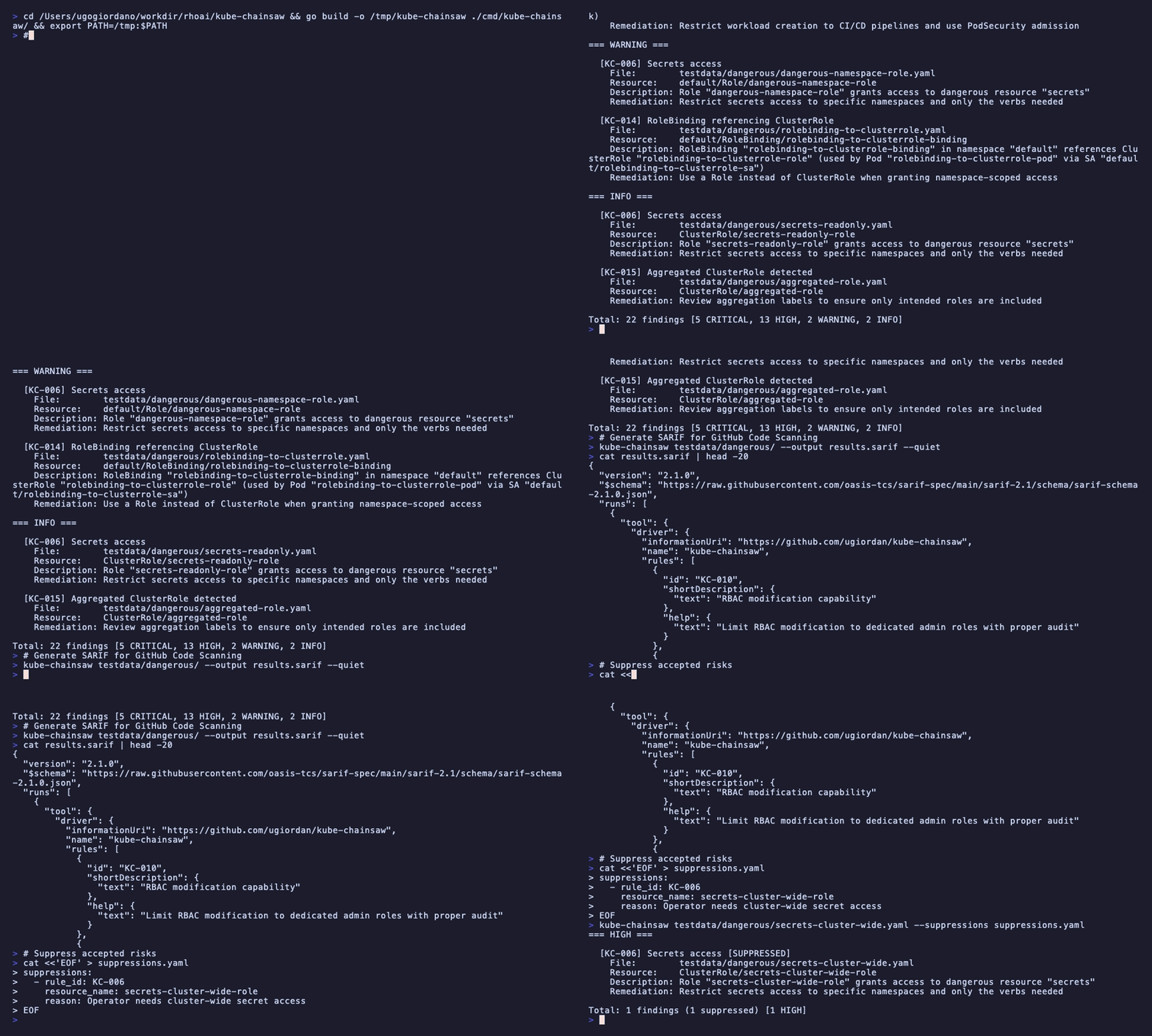
How It Works
kube-chainsaw analyzes Kubernetes RBAC, workload security contexts, NetworkPolicy manifests, and OpenShift SCC assignments by building a directed graph of permissions and checking declared security posture.
graph LR
    subgraph Input
        A[YAML Manifests]
        A2[Live Cluster]
    end

    subgraph "kube-chainsaw"
        B[Loader] --> C[Graph Builder]
        C --> D[31 Detection Rules]
        D --> E[Severity Engine]
    end

    subgraph Output
        F[Console]
        G[JSON]
        H[SARIF 2.1.0]
    end

    A --> B
    A2 -->|kubectl| B
    E --> F
    E --> G
    E --> H
Pipeline:
- Loader parses YAML manifests from local files or fetches them from a live cluster via kubectl (RBAC resources, workloads, Services, Ingresses, NetworkPolicies, and optional OpenShift resources)
- Graph Builder maps SA -> Binding -> Role -> verb/resource permission chains
- 31 Detection Rules (KC-001 through KC-031) identify dangerous patterns, wildcards, escalation paths, broad NetworkPolicy peers, workload security issues, exposure, Secret, and OpenShift SCC risks
- Severity Engine adjusts RBAC severity by binding scope and assigns explicit posture severity to workloads, NetworkPolicies, and SCCs
Quick Example
Given a Kubernetes operator with overly permissive RBAC:
# roles.yaml
apiVersion: rbac.authorization.k8s.io/v1
kind: ClusterRole
metadata:
  name: my-operator-role
rules:
  - apiGroups: [""]
    resources: ["secrets"]
    verbs: ["get", "list", "watch", "create", "update"]
  - apiGroups: ["rbac.authorization.k8s.io"]
    resources: ["clusterrolebindings"]
    verbs: ["create", "patch"]
---
apiVersion: rbac.authorization.k8s.io/v1
kind: ClusterRoleBinding
metadata:
  name: my-operator-binding
roleRef:
  apiGroup: rbac.authorization.k8s.io
  kind: ClusterRole
  name: my-operator-role
subjects:
  - kind: ServiceAccount
    name: my-operator-sa
    namespace: default
Run kube-chainsaw:
=== HIGH ===

  [KC-006] Secrets access
    File:        config/roles.yaml
    Resource:    ClusterRole/my-operator-role
    Description: Role "my-operator-role" grants access to dangerous resource "secrets"
    Remediation: Restrict secrets access to specific namespaces and only the verbs needed

  [KC-010] RBAC modification capability
    File:        config/roles.yaml
    Resource:    ClusterRole/my-operator-role
    Description: Role "my-operator-role" grants access to dangerous resource "clusterrolebindings"
    Remediation: Limit RBAC modification to dedicated admin roles with proper audit

  [KC-011] Privilege escalation via role/binding modification
    File:        config/roles.yaml
    Resource:    ClusterRole/my-operator-role
    Description: Role "my-operator-role" can create/modify roles or bindings (privilege escalation risk)
    Remediation: Restrict ability to create/modify roles and bindings to admin users only

Total: 3 findings [3 HIGH]
Generate SARIF for GitHub Code Scanning:
Comparison
| Tool | Static Analysis | Live Cluster | Graph Traversal | Privilege Chains | Workload Analysis |
|---|---|---|---|---|---|
| kube-chainsaw |  |
|
|
|
|
| kube-linter | |
 |
|
|
|
| KubiScan | |
|
|
|
|
| rbac-tool | |
|
|
|
|
| kubectl-who-can | |
|
|
|
|
kube-chainsaw performs graph traversal on YAML manifests or live clusters to detect privilege escalation chains. It works pre-deployment on static files or post-deployment via --from-cluster.
Features
-
Graph Traversal
Builds SA -> Binding -> Role -> verb/resource permission graphs. Detects multi-hop privilege escalation paths that flat rule-based linters miss.
-
Static + Live Analysis
Analyzes manifests before deployment or scans a live cluster via
--from-cluster. Works in CI pipelines, local development, and production audits. -
SARIF Output
Native SARIF 2.1.0 for GitHub Code Scanning, GitLab SAST, and other security platforms. Includes fingerprints for deduplication.
-
CI-First Design
Exit codes, machine-readable output, and suppression files designed for automated security gates in CI/CD pipelines.
What Gets Detected
31 detection rules covering:
| Category | Rules | Examples |
|---|---|---|
| Wildcard permissions | KC-001, KC-002 | resources: ["*"], verbs: ["*"] |
| Dangerous verbs | KC-003, KC-004, KC-005 | escalate, impersonate, bind |
| Sensitive resources | KC-006 to KC-010 | secrets, pods/exec, nodes, PVs, clusterrolebindings |
| Escalation combos | KC-011, KC-012 | create/patch on roles/bindings, workload creation |
| Privilege chains | KC-013, KC-014 | cluster-admin pods, RoleBinding->ClusterRole |
| Aggregation | KC-015 | aggregated ClusterRoles |
| NetworkPolicy | KC-016 to KC-018 | NetworkPolicy access, broad ingress and egress peers |
| Workload security | KC-019 to KC-022 | privileged containers, host namespaces, hostPath, dangerous capabilities |
| OpenShift SCC | KC-023 to KC-024 | SCC use permissions and permissive assignments |
| Exposure | KC-025 to KC-027 | external Services, unencrypted routes, broad hosts |
| Secrets and certificate access | KC-028 to KC-031 | credential manifests, token Secrets, token minting, CSR approval |
See Detection Rules for the full reference with YAML examples.